


Vyshenki, Boryspil district, Kyiv region: all about the village and the area
Just 15 km from the capital is the village of Vyshenky in the Kyiv region – a wonderful area where nature is revealed in all its pristine beauty. This is more than just a beautiful rural corner, of which there are many around Kyiv. Vyshenky is a real pearl of the Dnieper region, famous for its fascinating history, numerous archaeological sites and picturesque landscapes that attract lovers of peace and harmony.
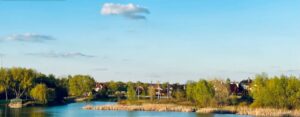
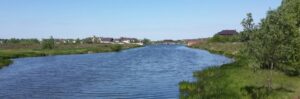
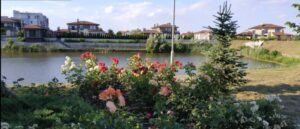
Although once you have visited Vyshenky in the Kyiv region, you will want to return here again and again. Green hills turn into sand dunes of the floodplain of the left bank of the Dnieper. The air is saturated with the aroma of meadow flowers, forest areas whisper about ancient secrets, and large fields beckon for a walk at dawn, when the sun gilds the crowns of trees. But the real treasure of Vyshenky is water – there is an abundance of it here. The Dnieper Bay, majestic and calm, stretches near the very borders of the village, offering views of the endless expanse of water. And Lake Zoloche, with its crystal clear water, adds charm: here you can relax for hours on the sandy beach, fishermen praise their rich catches, and families enjoy picnics by the shore.
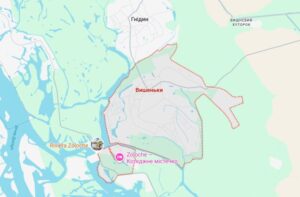
One of the key advantages of Vyshenki is the 20-minute accessibility of the capital’s locations. Want to live in Vyshenki and lead an active rhythm of Kyiv life? Many do just that. In the morning you enjoy a jog along the lakeshore, and in the afternoon you do business in the financial center of the country. Living in nature and working in IT companies, banks or creative agencies of the capital becomes a reality. The Hydropark or VDNH are calling for a weekend with the family, the capital’s theaters and cinemas are available for evening visits, and the bars and restaurants of Khreshchatyk, Pechersk and Podil offer exquisite cuisine. And although the cottage town of Zolochie has its own infrastructure: tennis courts, shops, cafes and even spa hotels, the proximity to Kiev always allows you to supplement it with something exquisite – from fashion exhibitions to gastronomic festivals.
In a word, Vyshenki is the embodiment of the dream of living in harmony: nature nourishes the soul, and Kiev – ambitions. Here you do not sacrifice anything and get everything: the freshness of the morning by the water, the air imbued with the aromas of various herbs, and the dynamics of a weekend in a metropolis. This is a unique place where you can raise your children in the fresh air, give them an excellent education at a prestigious local school, lead a healthy lifestyle and remain in the center of the capital’s business and cultural life.
Here, on the shores of the Dnieper Bay and a large lake, the life of the residents of the elite cottage town of Zolochie flows measuredly, like the waters of a large river, giving peace and joy. This place is a real paradise for those who dream of silence, beauty, clean air and plenty of water, but are not ready to sacrifice the comfort and opportunities of a large metropolis.
History of the village of Vyshenky, Kyiv region
The lands surrounding the village of Vyshenki in the Kyiv region are like old family albums: full of testimonies about past eras, great people and amazing destinies. The efforts of archaeologists have already revealed many historical secrets, thanks to which Vyshenki has gained the fame of an archaeological treasury. For example, in the tract of Obirki, just a kilometer north of Vyshenki, there is a settlement from the Early Iron Age – the 7th-6th centuries BC. And in total, scientists have discovered 17 burial grounds, sites, settlements and villages in various places on the surrounding lands, belonging to the Stone Age, Bronze Age, Neolithic and Trypillian culture.
In the Protsiv forest, between Vyshenki and the neighboring village of Protsiv, fragments of vessels from the Copper Age and traces of the Middle Dnieper culture – this is about the 2nd-1st millennium BC. There, in the sand dunes on the left bank of the Dnieper, is the famous burial ground of Vyshenki – a monument of the Zarubynets culture (2nd century BC), which became a window into the world of the ancient Slavs.
In the chronicles, the place where modern Vyshenki stands was first mentioned in 1101. When there was a threat of an attack by the Polovtsy, Vladimir Monomakh summoned “all the brothers” (princes) to gather “at Zoloch and Lake Dolobsky” for a military council. The documented history of Vyshenki continues in 1501, when the Grand Duke of Lithuania presented the village to the tovmach Berendey, and in 1562 the estate, together with the peasants, was transferred to the Kiev-Pechersk Lavra by the Kiev mayor Semen Meleshkevych, who had previously bought Vyshenki for 120 Lithuanian coins.
A few more dated events:
- In 1569, Vyshenki with all the neighboring lands were captured by Poland;
- In 1632, Kyiv Metropolitan Rogoza took Vyshenki from the Pechersk Lavra;
- In 1632, by the will of Metropolitan Petro Mohyla, Vyshenki was returned to the Pechersk Lavra;
- In 1648, during a peasant revolt, the threshing floor and mill were taken from the lord;
- At the end of 1648, Bohdan Khmelnytsky ordered Vyshenki to be transferred to a nunnery in Kyiv, and later the village was returned to the Pechersk Lavra;
- In 1666, the census book contains a record of exorbitant in-kind and monetary obligations imposed on the peasants Vyshenki.
During the Cossack era, Vyshenki was part of the Boryspil Hundred of the Kyiv Regiment, and the residents here were mostly subjects of monasteries and the Cossack foremen. The residents of Vyshenki lived by farming, fishing, and beekeeping. In 1786, the serfs became state peasants, and Vyshenki went to the treasury.
At the end of the 19th century, the population of Vyshenki rapidly became impoverished, which forced many to move to Siberia and the Far East. Those who remained, in order to survive, went to work as hired laborers and day laborers in the southern regions, some mastered handicrafts and crafts (cooperators, shoemakers, tailors). Judging by the fact that by that time three summer fairs and weekly market days had begun to be held in Vyshenki, life for the villagers soon began to improve. Some goods, such as towels and tablecloths, were even taken for sale to Kyiv.
The twentieth century burst into Vyshenki with a whirlwind of changes and tragedies. During the Civil War, the area saw fighting, and then came the collectivization of the 1930s: peasants were united in collective farms, and the land became common property. Many families suffered, but the village survived. World War II also left a deep mark – in Vyshenki there is a mass grave of Soviet soldiers and a monument to fellow villagers who died on the fronts (built in 1957).
After the war, Vyshenki began to turn into a summer paradise for Kyiv residents. The proximity to Boryspil and Kyiv made the village attractive for recreation. Given the outstanding natural resources of Vyshenki in the Kyiv region, 25 years ago a decision was made to begin construction of the Zolochie cottage town here. And although the spirit of the old village still lingers in the air, Vyshenki today is a modern settlement that has become the starting point for building a city of the future, synthesizing exquisite architecture, complete infrastructure and the freedom of country life.
Zoloche: a cottage village in Vyshenki, where the future has already come
In the late 1990s, when Ukraine was just starting to emerge from the turbulence of the post-Soviet years, a group of enthusiastic architects and investors decided to create a country village that would become an alternative to the stuffy apartments of the capital. The construction of the cottage town of Zoloche started about 25 years ago, in 2000, when the first foundations began to be laid on a large territory of 48 hectares. The idea was ambitious: not just scatter houses across the fields, but to build a full-fledged town with its own ecosystem, inspired by European models adapted to Ukrainian realities.
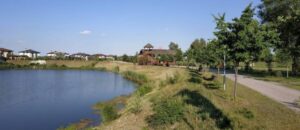
The first to appear were trial cottages in a classical style, and the engineers thought about how to integrate the village into the landscape of Vyshenki – taking into account the proximity of the Dnieper, forests and fertile lands. Back then, no one could have predicted how much the project would grow. At the start, it was a serious challenge: limited resources, which were compensated only by enormous enthusiasm. In the first years, the basic infrastructure was built – roads, communications and several blocks. The cottages were designed with an emphasis on energy efficiency: thick walls, large windows for natural light, rainwater harvesting systems.
Gradually, Zolochie evolved, attracting families tired of the city bustle and turning into a symbol of progress. Today, looking back, we can say: what began as a bold idea has become a home for hundreds of families, and the town is a benchmark for modern suburban housing.
Zoloche has grown to six huge districts, each of which is like a separate world with a unique character and a beautiful name: Zoloche 1, Zoloche 2, Zoloche Vezuviy, Riviera Zoloche, Riviera Zoloche DeLuxe, Zoloche Provence. For example, Zoloche Provence transports you to the atmosphere of the French province with lavender motifs in the design; Zoloche Vesuviy is a dynamic quarter in a modern style. In total, there are about 300 cottages, scattered over plots of 6 to 14 acres, which provides space for gardens, swimming pools and even mini-farms.
Zoloche Cottages are a true work of art: exquisite architecture combines classic and modern, with facades made of natural stone, wood and brick. Two-story houses with attics, panoramic windows overlooking the lake and barbecue terraces: inside – spacious layouts, 4-5 rooms, fireplaces, smart lighting and climate control systems. And outside – landscape design: illuminated alleys, fountains and green areas. These are spaces where every resident feels like the creator of their own world, and ecology comes first: solar panels, recycling, and a ban on harmful materials.
What makes Zolochie a city of the future is, of course, the infrastructure that covers all urgent needs without forcing you to leave the town. There is no room for improvisation here: everything is thought out to the smallest detail, like in any smart city: wide asphalt roads, a 24-hour taxi service for trips to Kyiv (just 15-20 minutes to the metro), and even bike paths for ecological transportation.
Security is also at its best – a closed territory with a checkpoint, 72 video surveillance cameras, 24-hour security, and sensors in each house connected to the central system. Guests? By invitation only, to maintain privacy.
The social network is a special pride. There is its own school for children, a kindergarten with playgrounds, sports complexes with swimming pools, tennis courts and fitness rooms. For health – the Boris medical clinic with emergency care and a pharmacy. Food? The Hamon grocery market with fresh farm products, a coffee shop for a morning espresso. And all this against the backdrop of magnificent nature: 70% of the territory is parks, forests and reservoirs.
Zoloche and its connection with the history of Vyshenki: a future rooted in the past
Although Zoloche is a closed territory where residents lead their measured, almost autonomous lives, the town is not at all cut off from the outside world. On the contrary, it is harmoniously inscribed in the great history of Vyshenki – a land with ancient burial mounds and Cossack traditions, which were mentioned earlier. Here, against the backdrop of modern cottages, you can still feel the breath of the past: the Protsivskyi reserve, where centuries-old oaks whisper, or the Dnieper bank, which has seen Slavic boats and princely flotillas.
KM Zolochie respects this amazing area, finding a balance between the past and the future, which makes the ancient Vyshenki even more beautiful. If you are looking for a place where tomorrow begins today, Zolochie is ready to welcome you.


